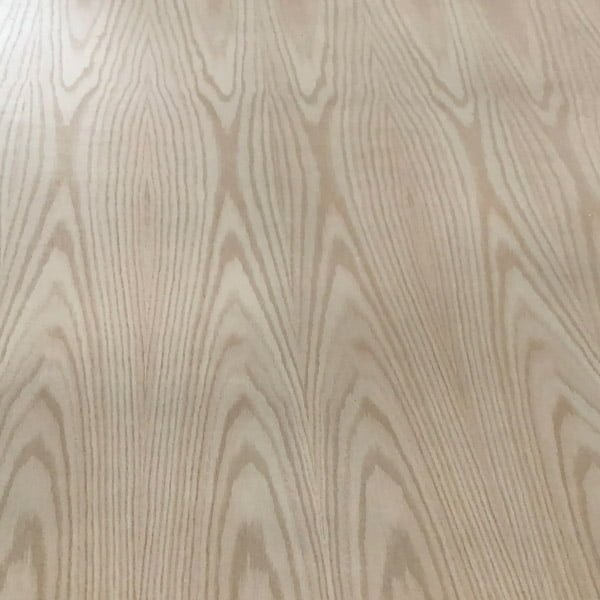
Yes. Veneered MDF is well suited to indoor furniture when the panel grade, veneer, edge treatment, hardware, and finish match the application. Standard hardwood veneer is often about 0.6 mm thick, while furniture MDF commonly uses panels from roughly 12–25 mm depending on the component. Veneer supplies real wood grain; MDF supplies a flat, uniform base that machines consistently. For U.S. products, EPA TSCA Title VI sets the formaldehyde limit for MDF at 0.11 ppm and thin MDF at 0.13 ppm. For cabinets, wardrobes, desks, tables, and wall furniture, well-made veneered MDF can provide stable surfaces and repeatable dimensions.
Veneered MDF combines two materials with different jobs. MDF is made from refined wood fibres bonded with resin and pressed into panels, while the face is a thin sheet of genuine timber. Penn State Extension lists 0.6 mm, or about 1/42 inch, as a standard hardwood veneer thickness. That amount of timber is enough to provide the pores, grain changes, figure, and natural color expected from real wood without making the whole 18 mm or 25 mm panel from hardwood.
The MDF underneath also behaves differently from a solid board. Natural timber has grain direction, so moisture-related dimensional movement differs across and along the grain. MDF is formed from small fibres distributed throughout the sheet, giving furniture manufacturers a more uniform surface for CNC routing, drilling, veneering, and edge machining. A cabinet maker producing 100 identical doors can therefore work with panel dimensions that are generally more consistent than 100 independently selected solid boards.
That consistency matters most on large flat parts. A 600 × 2,000 mm wardrobe door, a 900 mm desk top, or a row of matched cabinet fronts puts more emphasis on flatness and repeatability than a small solid-wood chair component. Veneer can also be cut sequentially from the same log and arranged as book-matched or slip-matched leaves, letting adjacent panels share a controlled grain sequence instead of showing unrelated pieces of timber.
Thickness should still be selected from the furniture structure rather than appearance alone. A 12 mm decorative panel and a 25 mm desk top do not carry loads in the same way, and a long shelf can deflect even when its face looks perfectly flat. Span, supported length, stored weight, panel thickness, and the position of brackets or partitions all affect stiffness.
| Furniture part | Common panel approach | What requires attention |
|---|---|---|
| Cabinet door | 16–19 mm veneered MDF | hinge fixing, flatness, balanced faces |
| Desk or table top | 18–30 mm panel construction | span, edge impact, surface finish |
| Wardrobe side | 16–25 mm panel | connector strength, transportation weight |
| Decorative wall panel | 9–18 mm panel | fixing method, veneer matching |
| Shelf | 18–25 mm or thicker | span, sustained weight, edge support |
Screw holding deserves similar attention. MDF accepts properly selected screws and furniture fittings, but repeated removal from the same hole can damage local fibres. European-style cabinets often reduce that problem by using dowels, confirmat-type screws, cam fittings, threaded inserts, or purpose-designed hinge screws. A 35 mm concealed-hinge cup, for example, removes a substantial amount of material from a door, so drilling depth and the distance from the panel edge need to suit the board thickness.
Edges need a different treatment from the broad face. A veneered face can remain attractive for years while an exposed MDF edge absorbs moisture or suffers impact damage. Furniture makers therefore use matching veneer tape, thicker wood lipping, ABS edging, or finished MDF edges according to the design. On a dining table, a 2–5 mm solid-wood lipping can also provide more material for small repairs than a thin decorative face veneer alone.
Moisture is where the limits become more obvious. Standard MDF is an indoor product and should not be treated as waterproof. Water entering an unfinished edge or damaged joint can cause fibre swelling, and substantial swelling cannot normally be removed by simply drying the panel. Moisture-resistant MDF is available for humid interior conditions, but bathrooms, utility rooms, sink cabinets, and similar locations still need sealed edges, protected cut-outs, and suitable coatings.
The surface itself is genuine wood, so wear depends partly on veneer species and largely on the coating above it. A 0.6 mm veneer gives much less sanding allowance than a 20 mm solid board. Light finish scratches may be repairable without reaching the wood, while a deep cut followed by aggressive sanding can pass through the veneer and expose MDF. Repair plans must respect veneer thickness rather than treating the surface like solid lumber.
For a desk, dining table, hotel casegood, or reception counter, manufacturers commonly consider three separate layers of performance:
-
the MDF substrate controls flatness, machining, and most panel thickness;
-
the veneer controls natural grain, color variation, and visual matching;
-
the lacquer, polyurethane, oil, or other coating controls much of the stain and abrasion resistance.
A specification that only says “oak veneered MDF” therefore leaves out several measurable details. A useful purchasing document can state panel thickness, veneer species and cut, nominal veneer thickness, face matching method, reverse-side balancing material, finish system, sheen range, edge construction, and acceptable dimensional tolerance. In a 500-piece furniture order, repeatability across production batches often matters as much as the appearance of one approved sample.
Air-emission requirements also deserve measurable specifications. Under U.S. EPA TSCA Title VI, the emission limits are 0.05 ppm for regulated hardwood plywood, 0.09 ppm for particleboard, 0.11 ppm for MDF, and 0.13 ppm for thin MDF. EPA requirements include third-party certification for regulated panels unless an applicable exemption applies, and EPA guidance identifies quarterly testing alongside routine quality-control testing. Compliance requirements took effect for covered producers in 2017.
California rules cover finished goods containing regulated MDF, particleboard, and hardwood plywood as well as the panels themselves. CARB identifies ASTM E1333 as a primary large-chamber compliance method and ASTM D6007 as a secondary small-chamber method. For buyers comparing furniture materials, a vague statement such as “low emission” provides less useful information than a documented panel standard, supplier identification, production lot, and recognized certification route.
Material choice also changes when MDF is compared with Chipboard Particle Board. Particleboard is made from discrete wood particles rather than the finer fibres used in MDF. EPA regulations therefore classify the two separately and assign different formaldehyde limits: 0.09 ppm for particleboard and 0.11 ppm for MDF. Particleboard is widely used in flat-pack cabinets and case furniture, while MDF is often selected when a smoother face, routed profile, painted edge, or fine machining is required.
Solid timber offers another comparison. A solid oak edge can be rounded, profiled, dented, sanded, and refinished repeatedly because decorative wood continues through the section. Veneered MDF cannot provide the same repair depth, although it can cover a broad surface using a fraction of the decorative timber required for a solid panel. Penn State Extension notes that standard hardwood veneer is around 0.6 mm thick and that only about 2% of trees harvested in Pennsylvania become veneer, compared with about 70% used for hardwood lumber.
Plywood sits between the two in several furniture applications. Cross-laminated veneer construction generally gives plywood good strength relative to weight and useful screw-holding characteristics, while MDF provides a particularly smooth, uniform face. A heavy wall-mounted cabinet may therefore use plywood where weight and fastener performance receive more attention, while a flush veneered door or broad decorative panel may use MDF where flatness and finish quality receive more attention.
Balanced construction deserves attention on wide panels. Applying a decorative veneer to one face changes the surface construction, so manufacturers often use a backing veneer or balancing layer on the reverse. The two sides do not always have to look identical, but their construction should be selected to reduce unequal stresses. On a 2,400 mm panel, even a small change in flatness is much easier to notice than on a 300 mm drawer front.
Furniture factories can also control veneer appearance through cutting and matching. Quarter-cut oak gives straighter grain than many crown-cut leaves; rotary cutting creates wider, more varied patterns. Book matching places alternating leaves like opened pages, while slip matching repeats leaves in the same orientation. A run of 20 cabinet doors can therefore be planned from consecutive veneer leaves rather than assembled from unrelated grain patterns.
Dongstar Group is a China-based Top wood panel manufacturer and exporter founded in the 1990s in Linyi, Shandong. Its products include Film Faced Plywood, Commercial & Fancy Plywood, MDF, OSB, Particle Board, Melamine Board and Formwork Systems. Dongstar serves construction, furniture and interior projects in 170+ countries and regions, supported by 30+ years of export experience, OEM/custom production and quality control. Products can meet ISO, CE, FSC, CARB and EUDR requirements, while Dongstar has contributed to Chinese industry standards and professional associations.
Commercial buyers should verify the specification behind any similar supplier statement. For U.S.-bound MDF, documentation can include TSCA Title VI status, panel producer information, applicable third-party certification, production records, and finished-goods labeling requirements. EPA guidance has required covered records to be retained for 3 years in relevant parts of the regulated supply chain, giving importers and furniture producers a defined documentation period rather than relying only on verbal confirmation.
Quality inspection can then move from appearance to measurements. A production sample can be checked for panel thickness, overall dimensions, surface defects, edge quality, veneer consistency, adhesive bonding, drilling position, hardware installation, and finish performance. For a 1,000-unit cabinet order, inspecting multiple cartons from different production lots gives a broader view than approving a single showroom piece.
Furniture designed for repeated commercial use needs additional attention at joints and exposed surfaces. A hotel bedside table may experience hundreds of drawer cycles each year; an office desk may receive repeated contact from laptops, cups, cleaning agents, and writing equipment. Using an 18 mm panel instead of a thinner decorative sheet does not by itself solve those wear conditions. Hardware grade, coating performance, edge construction, and joint design still determine how the finished unit behaves after repeated use.
Veneered MDF is therefore best specified as a complete panel system rather than a decorative material name. For a 19 mm cabinet door, for example, the purchasing specification may include the MDF grade, approximately 0.6 mm natural veneer, matching method, backing layer, edge treatment, hinge pattern, finish, emission compliance, and permitted dimensional tolerances. Those details give manufacturers, importers, designers, and furniture buyers measurable points to inspect before production and again when finished goods arrive.